
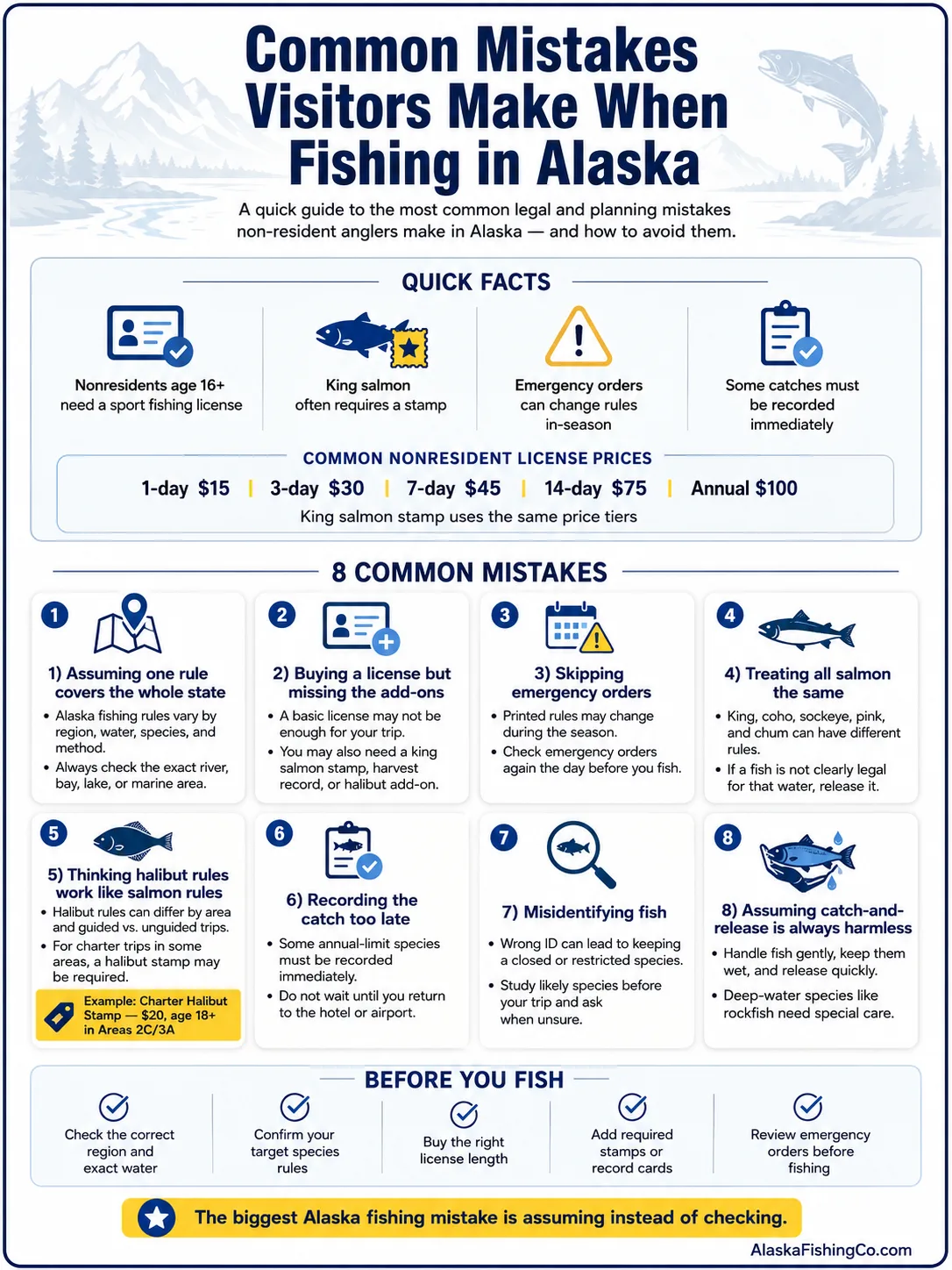
Most Alaska fishing mistakes happen before the first cast: the angler buys the wrong license, reads the wrong region page, or misses an emergency order. Visitors can fish safely and legally in Alaska, but they need to match the license, species, location, and date before they fish.
Alaska is not a one-rule-fits-all fishing destination. A salmon trip near Anchorage, a halibut charter out of Homer, a trout day on the Kenai, and a shore-fishing stop in Southeast Alaska can all involve different limits, stamps, harvest records, or closures. The safest approach is simple: check the current Alaska Department of Fish and Game rules for the exact water you plan to fish, then confirm whether your target species adds another requirement.
If you remember one thing… do not assume your Alaska fishing license is the only rule that matters. A legal fishing day usually depends on your age, residency, species, region, method, and the most current emergency orders.
What To Know First
- Nonresidents age 16 and older need an Alaska sport fishing license. Residents need one at age 18 and older.[a]
- Foreign visitors are treated as nonresidents for sport fishing license purposes. The published sport fishing prices for foreign/alien nonresidents match the standard nonresident sport fishing license prices.[b]
- King salmon often adds a stamp requirement. A king salmon stamp is required to fish for king salmon, except for king salmon in stocked lakes and certain youth or exempt resident categories.
- Emergency orders can change the rules during the season. They may close an area, change bag limits, or change allowed fishing methods.
- Charter halibut has extra rules. Halibut is managed under federal and international processes, and charter rules can differ from unguided rules.
- Annual-limit species must be recorded. Some salmon, trout, lingcod, rockfish, and other fisheries may require harvest recording.
Mistake 1: Thinking One Alaska Fishing Rule Covers the Whole State
Alaska fishing rules are regional. The right answer depends on where you are fishing, what species you are targeting, whether you are guided, and whether a current order has changed the published regulation.
Visitors often hear “Alaska fishing license” and think the rest is simple. The license gives permission to participate, but it does not erase area limits, size limits, annual limits, closures, bait restrictions, or stamp requirements. A river can be open for one species and closed for another. Saltwater can have different rules from nearby freshwater. A youth-only fishery can still have gear restrictions.
- Check the statewide rules first.
- Then check the region: Southeast, Southcentral, Southwest, or Northern.
- Then check the exact drainage, bay, river, lake, or marine area.
- Then check current emergency orders before fishing.
ADF&G tells anglers to select a region, review region-wide regulations, then look at the drainage or area they will fish. It also states that emergency orders supersede the published regulations.[d]
Mistake 2: Buying the License But Missing the Stamp or Record Card
A license is only the starting point. Some Alaska fishing trips also require a king salmon stamp, a harvest record card, or a charter halibut stamp depending on the species and situation.
Nonresident sport fishing licenses are sold in 1-day, 3-day, 7-day, 14-day, and annual options. Current published nonresident sport fishing license prices are $15, $30, $45, $75, and $100 respectively. Nonresident king salmon stamps use the same 1-day, 3-day, 7-day, 14-day, and annual structure, with prices of $15, $30, $45, $75, and $100.
Annual licenses are valid from the purchase date through December 31 of that calendar year, while short-term nonresident fishing licenses are valid only for the chosen number of days.[c]
| Visitor situation | Common mistake | Better move |
|---|---|---|
| Adult tourist fishing for salmon | Buying only a sport fishing license and assuming it covers all salmon | Check whether king salmon is targeted or possible, then add a king salmon stamp if needed |
| Family with teenagers | Using resident age rules for nonresident children | Remember that nonresidents need a sport fishing license at age 16 and older |
| Foreign visitor | Looking for a special tourist license category | Use the nonresident/foreign visitor sport fishing license category and match the trip length |
| Halibut charter client | Assuming the charter operator’s paperwork covers the angler | Carry your Alaska sport fishing license and confirm any charter halibut stamp process before fishing |
| Angler keeping annual-limit species | Waiting until later to write down the catch | Record the species, date, and location immediately when the regulation requires it |
Worth Noting
A charter booking does not make your personal license responsibility disappear. Ask the operator what you must bring, but still verify your own license, stamp, and age requirement before the trip.
Mistake 3: Not Checking Emergency Orders on the Day Before Fishing
Emergency orders are one of the easiest Alaska rules for visitors to miss. They can change an open season, close a water, reduce a bag limit, or change legal gear after printed or saved regulations were published.
This matters most when salmon runs are weaker than expected or when managers need to protect a stock during the season. A visitor may read a regulation booklet in March, book lodging in April, and fish in July under a different set of rules.
ADF&G says emergency orders may be issued at any time and have the same force and effect as law. The emergency order page is updated frequently, and anglers are told to check it before fishing for the most current regulation information.[e]
- Check emergency orders after booking the trip.
- Check again a few days before fishing.
- Check once more the evening before, especially for king salmon.
- Save or screenshot the relevant page only after confirming the date.
Mistake 4: Treating All Salmon the Same
Salmon rules in Alaska can differ by species. King salmon, coho, sockeye, pink, and chum salmon may have different seasons, bag limits, size rules, recording rules, and closures.
The most common visitor error is using the word “salmon” too broadly. A river might allow sockeye but restrict king salmon. A marine area may have a king salmon annual limit for nonresidents. A person fishing for coho might accidentally hook a king salmon and not know whether retention is allowed.
- King salmon: usually the species most likely to require a stamp and special attention.
- Sockeye salmon: often targeted in rivers where method, location, and timing matter.
- Coho salmon: popular later in the season, but still area-specific.
- Pink and chum salmon: often easier for new visitors to identify incorrectly when fish are bright or changing color.
One safe habit is to decide before fishing what species you are willing to keep. If a fish is not clearly legal for that exact water, release it carefully and quickly.
One Detail People Miss
A king salmon stamp is about fishing for king salmon, not only keeping one. If king salmon is the target, confirm the stamp requirement before casting.
Mistake 5: Forgetting That Halibut Rules Are Different From Salmon Rules
Halibut is not managed like a regular freshwater sport fish. Alaska halibut fishing is shaped by federal rules, IPHC areas, guided versus unguided status, and annual charter regulations.
Visitors often book a halibut charter and assume the same rule applies everywhere from Ketchikan to Homer. That can be wrong. Charter halibut regulations in Areas 2C and 3A are set annually through federal and international management processes, while unguided rules can differ from guided rules.[f]
For 2026, ADF&G states that all charter anglers age 18 and older must have a Charter Halibut Stamp to keep halibut in Areas 2C or 3A. The same ADF&G page lists the stamp cost as $20 per angler age 18 and older and explains that stamp use must be entered before gear is deployed.[g]
- Ask whether your trip is in IPHC Area 2C, 3A, or another area.
- Ask whether the trip is guided or unguided.
- Confirm daily limits, size rules, closed days, and any stamp process.
- Do not assume last year’s halibut rule still applies.
Mistake 6: Recording the Catch Too Late
When a regulation requires a harvest record, the catch must be recorded as directed. Waiting until the hotel, campground, or airport can create a problem.
This mistake is common because many visitors are used to places where a license is just proof of payment. Alaska can require more. Some fisheries have annual limits, and the state needs the angler to record the catch so the limit follows that person through the season.
- Carry your license or electronic license while fishing.
- Carry any required harvest record card.
- Have a pen or working phone method ready before fishing.
- Record the catch immediately when the rule says to do so.
This matters for adults, youth, residents, and nonresidents when the species has an annual limit. Even anglers who do not need a sport fishing license because of age may still need a harvest record card for annual-limit species.
Before You Move On
Do not pack your license away in a dry bag you cannot reach. Keep it protected, but accessible enough to show and update when needed.
Mistake 7: Misidentifying Fish
Fish identification is not a small detail in Alaska. The wrong identification can lead to keeping a closed species, exceeding a limit, or mishandling a fish that should have been released.
This mistake shows up with salmon, trout, char, lingcod, and rockfish. It also happens when fish are ocean-bright on one day and colored up in a river a few days later. A visitor who has only seen salmon photos online may struggle when the fish is half-silver, dark-backed, or hooked in poor light.
- Study the species you are likely to catch before the trip.
- Save ADF&G identification materials where you can use them without service.
- Ask the charter captain or local biologist when unsure.
- Release fish you cannot identify as legal to keep.
Rockfish deserve special care. ADF&G explains that rockfish caught in deep water can suffer barotrauma and may die if released at the surface. The agency’s rockfish conservation page says deepwater release can improve survival, and it reports far higher survival for yelloweye rockfish released at depth than at the surface.[h]
Mistake 8: Assuming Catch-and-Release Is Always Harmless
Catch-and-release can be a good choice, but it still needs to be done correctly. In cold water, deep water, fast current, or bear country, poor handling can hurt the fish or create safety problems.
For salmon and trout, keep fish wet, use gentle handling, and release quickly when release is required. For rockfish, surface release may not be enough. For halibut and other saltwater fish, know whether the fish may be removed from the water before release.
- Use pliers or a dehooking tool when possible.
- Do not drag fish onto dry rocks or gravel if releasing them.
- Keep the fish in the water while removing the hook when practical.
- Stop fishing for a species if every hookup creates release problems.
Release Method Matters
“I released it” is not always enough. Some regulations tell anglers exactly how a fish must be released, and rockfish are the clearest example.
Mistake 9: Buying Online but Not Carrying the License Correctly
Buying online is normal in Alaska, but the license still needs to be carried in a valid format while fishing. A saved receipt is not always the same as a usable license.
ADF&G explains several license formats, including printed/electronic licenses and eSigned licenses. Printed or electronic licenses may need to be signed, while eSigned licenses purchased through an ADF&G account can be stored and viewed on an electronic device.
Online buying steps for visitors
- Choose the correct residency category.
- Select the license length that covers every fishing day.
- Add a king salmon stamp if you will fish for king salmon.
- Confirm whether any harvest record card is needed.
- Download or print the license before leaving reliable internet.
- Check that the name, date, and license period are correct.
- Carry a backup copy if fishing in remote areas.
Phones get wet, batteries die, and remote rivers may have no signal. A paper backup is not old-fashioned in Alaska; it is practical.
Common Mistakes Visitors Make
Most visitor mistakes come from assuming rather than checking. The fix is usually simple once the angler knows what question to ask.
Mistake: “My charter includes the license.”
Correct explanation: Some operators may help guests understand what to buy, but the angler is still responsible for having the correct license, stamp, or record requirement.
Why it gets confused: Visitors pay one large trip price and assume it covers all paperwork.
Mistake: “I only need a stamp if I keep a king salmon.”
Correct explanation: The king salmon stamp requirement applies to fishing for king salmon, with stated exceptions such as stocked lakes and certain youth or exempt categories.
Why it gets confused: Many anglers think stamps are only harvest tags.
Mistake: “The printed regulation booklet is always current.”
Correct explanation: Emergency orders can change published rules during the season.
Why it gets confused: Printed booklets and saved PDFs feel official, but Alaska fisheries can change quickly.
Mistake: “All salmon count the same.”
Correct explanation: Salmon rules can differ by species, location, size, date, and residency.
Why it gets confused: Trip descriptions often say “salmon fishing” without naming the exact species.
Mistake: “Nonresident child rules are the same as resident child rules.”
Correct explanation: Residents under 18 do not need a sport fishing license, while nonresidents under 16 do not need one. The ages are not the same.
Why it gets confused: Families often read one age rule and apply it to everyone.
Mistake: “If a fish swims away, it was released properly.”
Correct explanation: Some fish, especially rockfish affected by barotrauma, may need deepwater release to survive.
Why it gets confused: Surface behavior does not always show whether the fish will survive later.
Real-Life Scenarios for Alaska Visitors
These are the kinds of situations that cause trouble for otherwise careful visitors.
- A father and 16-year-old from California fish a river near Anchorage. The teenager needs a nonresident sport fishing license because the nonresident license age starts at 16.
- A couple from Germany books a one-day salmon charter. They should buy nonresident sport fishing licenses and confirm whether king salmon is targeted before deciding on a king salmon stamp.
- A family fishes from shore after reading last month’s regulation booklet. They should check emergency orders again because a closure or gear change may have been issued after the booklet was saved.
- A visitor catches a king salmon while mainly hoping for coho. The right action depends on the local rules, stamp status, and whether retention is open for that exact water.
- A halibut charter guest in Southcentral Alaska assumes halibut rules are the same as salmon rules. Halibut has separate federal and charter rules, so the guest should confirm the area, date, closed days, and stamp process.
- A traveler keeps a fish with an annual limit and plans to write it down later. If the rule requires immediate recording, “later” is too late.
- A visitor catches an orange rockfish while targeting halibut. The angler needs to know the rockfish category, whether retention is legal, and how to use deepwater release if the fish is not kept.
- A group shares one downloaded license screenshot on one phone. Each angler who needs a license should have their own accessible proof, not rely on one person’s phone.
How Visitors Can Avoid Most Alaska Fishing Mistakes
The best way to avoid mistakes is to build a short pre-fishing check around the exact trip. Do it before buying, before packing, and before leaving for the water.
Before buying
- Confirm your residency category.
- Check your age requirement.
- Choose the right license length.
- Add any needed king salmon stamp.
Before fishing
- Check the region and exact water.
- Read the species rule, not only the general salmon or trout rule.
- Check emergency orders.
- Confirm harvest record needs.
- Download maps and rules for offline use.
While fishing
- Keep your license accessible.
- Record required catches right away.
- Release uncertain fish.
- Stop and recheck rules if you move to another river, lake, bay, or marine area.
Nearby Water Can Mean Different Rules
Moving a few miles can change the rule. In Alaska, “nearby” does not always mean “same regulation.”
A Simple Rule Before You Cast
Alaska rewards preparation. Visitors who check license category, species rules, regional limits, and emergency orders usually avoid the mistakes that spoil a fishing day.
The most common error is assuming that a valid license means every nearby fishery is open and every target species is covered. The rule to remember is simple: license first, species second, exact water third, emergency order last.
Common Alaska Visitor Fishing Questions Answered
Do tourists need a fishing license in Alaska?
Yes, most tourists age 16 and older need a nonresident Alaska sport fishing license. Younger nonresident anglers usually do not need a sport fishing license, but they may still need a harvest record card for annual-limit species.
Can foreign visitors buy an Alaska fishing license online?
Yes. Foreign visitors can buy nonresident sport fishing licenses through the Alaska Department of Fish and Game licensing system. They should choose the correct nonresident or foreign visitor category and make sure the license dates cover every fishing day.
Do visitors need a king salmon stamp in Alaska?
Visitors generally need a king salmon stamp if they fish for king salmon, unless an exception applies. The stamp is separate from the sport fishing license and should be bought before targeting king salmon.
Is an Alaska fishing license enough for a halibut charter?
Not always. A sport fishing license is still needed for most adult visitors, but charter halibut can involve separate federal rules, area rules, closed days, size limits, and in 2026 a charter halibut stamp for anglers age 18 and older in Areas 2C or 3A.
Do Alaska fishing rules change during the season?
Yes. Alaska uses emergency orders to change seasons, bag limits, areas, or methods when needed. Visitors should check the current emergency orders shortly before fishing, not only when planning the trip.
What happens if a visitor catches a fish they cannot identify?
The safest choice is to release the fish carefully unless the angler can clearly identify it and confirm it is legal to keep in that exact water. Fish identification matters because rules can differ by species.
Do kids need an Alaska fishing license?
Resident anglers under 18 do not need a sport fishing license. Nonresident anglers under 16 do not need a sport fishing license. However, youth anglers may still need a harvest record card when fishing for species with annual limits.
Alaska Fishing References
- [a] ADF&G Sport Fishing Licenses, King Salmon Stamps, IDs and Harvest Record Cards — explains who needs an Alaska sport fishing license, when king salmon stamps apply, and when harvest record cards are needed. (Official Alaska Department of Fish and Game source.)
- [b] ADF&G Sport Fishing License and King Salmon Stamp Prices — lists current resident, nonresident, and foreign/alien nonresident sport fishing license and stamp prices. (Official Alaska Department of Fish and Game price page.)
- [c] ADF&G General License Information — covers license validity, license formats, age rules, and harvest record card basics. (Official Alaska Department of Fish and Game licensing FAQ.)
- [d] ADF&G Sport Fishing Regulations — provides the statewide entry point for Alaska sport fishing regulations by region and area. (Official Alaska Department of Fish and Game regulations page.)
- [e] ADF&G Emergency Orders and Press Releases: Sport Fishing — explains that emergency orders can open, close, or modify sport fisheries and should be checked before fishing. (Official Alaska Department of Fish and Game current order page.)
- [f] NOAA Fisheries: Sport Halibut Fishing in Alaska — explains guided and unguided Alaska halibut management, IPHC areas, and annual charter regulation process. (Official NOAA Fisheries source.)
- [g] ADF&G Charter Halibut Fishing — describes the 2026 charter halibut stamp requirement, cost, and how it is recorded for charter trips. (Official Alaska Department of Fish and Game charter halibut page.)
- [h] ADF&G Rockfish Conservation — explains rockfish barotrauma, deepwater release, and conservation practices for released rockfish. (Official Alaska Department of Fish and Game conservation page.)