
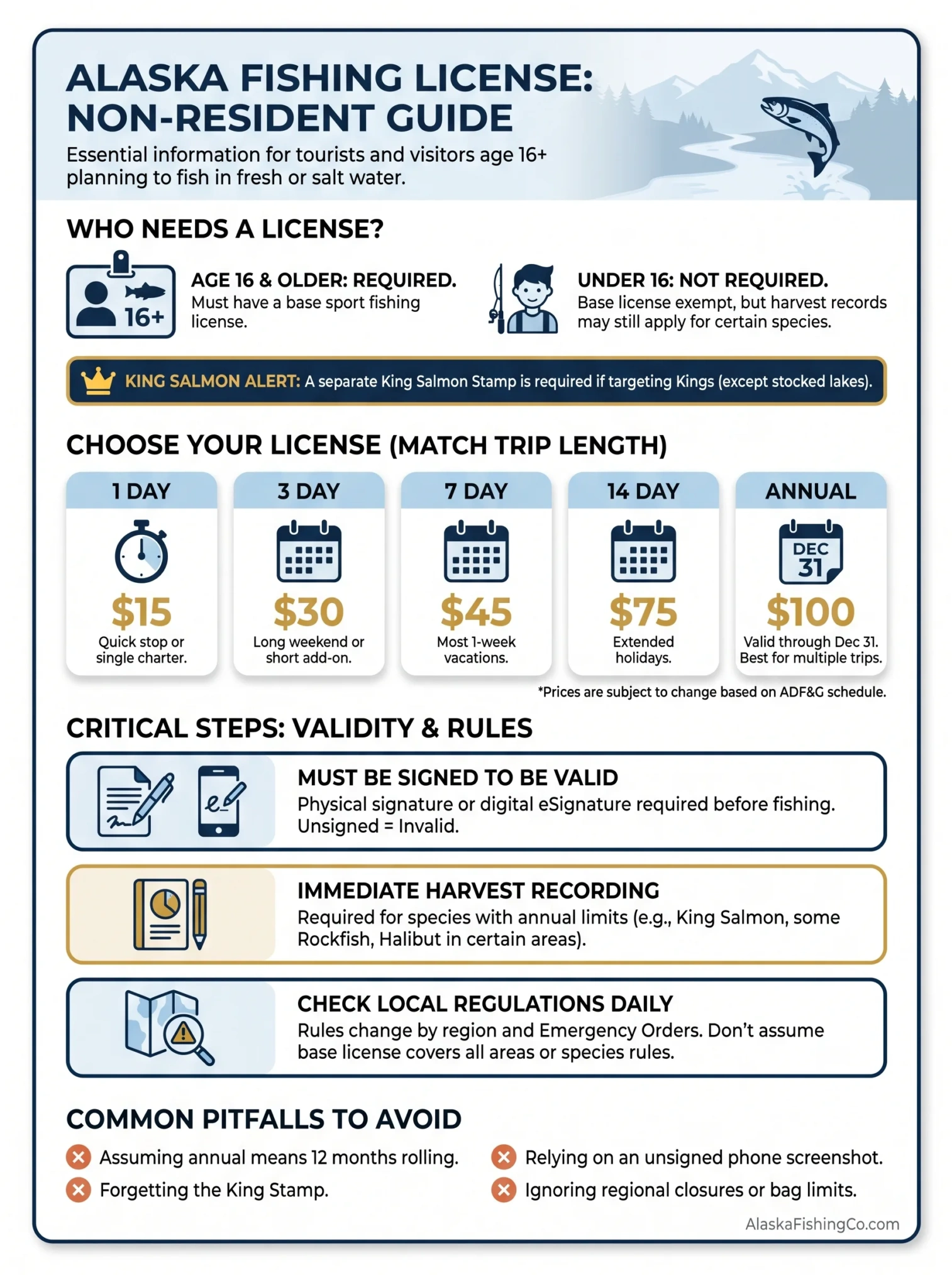
Non-residents age 16 and older need an Alaska sport fishing license to fish in Alaska, whether they are visiting from another U.S. state or coming from abroad. If king salmon are part of the plan, they also need a king salmon stamp, unless they are under 16 or fishing for king salmon in stocked lakes.[a]
That rule applies in both fresh water and salt water. For most visitors, the relevant questions are which license period covers the fishing dates, whether a king salmon stamp is required, and which regulations apply to the exact water being fished.
The base license must match the fishing dates. A king salmon stamp is required when king salmon are targeted, subject to the applicable age and stocked-lake exemptions. Regional regulations and emergency orders must be checked for the exact water and fishing date.
Key License Rules
- Non-resident sport fishing licenses are available for 1 day, 3 days, 7 days, 14 days, or the remainder of the calendar year.
- Annual licenses expire on December 31 rather than 12 months after purchase.
- Non-residents under 16 do not need the base sport fishing license.
- Foreign visitors can purchase the same fishing licenses and king salmon stamps as other non-residents.
- Species stamps, harvest records, federal rules, and local restrictions can apply in addition to the base license.
- Emergency orders can change fishing limits during the season.
Who Needs an Alaska Fishing License if They Do Not Live in Alaska?
A non-resident age 16 or older must hold an Alaska sport fishing license before fishing.
This requirement applies to tourists, cruise passengers, out-of-state travelers, lodge guests, road-trip visitors, and international visitors. Ordinary sport fishing licenses use the same non-resident category for visitors from other U.S. states and visitors from outside the United States.
- Age 16 and over: base non-resident sport fishing license required.
- Under 16: no base sport fishing license required.
- Fresh water and salt water: the same base sport fishing license covers both.
- King salmon: the stamp requirement is separate from the base license requirement.
Which Alaska Non-Resident License Should You Buy?
The license period should cover the number of days spent fishing rather than the total length of the Alaska visit.
Alaska sells short-term non-resident sport fishing licenses for 1, 3, 7, and 14 days, plus an annual option. The current ADF&G price schedule lists the same sport fishing license prices for standard non-residents and foreign visitors.[b]
| License type | Price | Suitable use | Validity |
|---|---|---|---|
| 1 Day | $15 | One charter or shore-fishing day | Valid for the selected day |
| 3 Day | $30 | Short visits and weekend trips | Valid for the selected three-day period |
| 7 Day | $45 | Trips with up to one week of fishing | Valid for the selected seven-day period |
| 14 Day | $75 | Longer fishing trips | Valid for the selected fourteen-day period |
| Annual | $100 | Multiple trips during the same calendar year | Valid through December 31 |
- Fishing for one to three days: the 1-day or 3-day license covers the selected period.
- Fishing for up to one week: the 7-day license covers the selected period.
- Fishing for up to two weeks: the 14-day license covers the selected period.
- Multiple trips in the same year: the annual license can cost less than buying several short-term licenses.
Cost Comparison
Two separate 14-day licenses cost $150. An annual non-resident sport fishing license costs $100 and remains valid through December 31 of the year in which it is purchased.
How Long Does a Non-Resident Alaska Fishing License Stay Valid?
Annual and short-term licenses have different validity periods.
Annual licenses are valid from the date of purchase through December 31 of that calendar year. Short-term non-resident licenses are valid only for the specific 1-day, 3-day, 7-day, or 14-day period purchased. Non-residents under 16 do not need the base sport fishing license, but harvest-record requirements can still apply when they retain species subject to annual limits.[b]
- Annual license: valid through December 31 of the purchase year.
- Short-term license: valid only for the purchased fishing period.
- Non-residents under 16: exempt from the base license but not necessarily from harvest recording.
Buying and Signing an Alaska Fishing License Online
ADF&G licenses can be purchased online before the fishing date. A purchased license is not valid until it carries the required physical signature or electronic signature.
A license can be printed and signed by hand or purchased through an ADF&G account using the eSigned format. When one person purchases licenses for several anglers, each angler must sign their own license.[c]
Online Purchase Requirements
- Select the license period that covers the actual fishing dates.
- Add the appropriate king salmon stamp when king salmon will be targeted.
- Apply a physical signature or approved electronic signature.
- Carry the license in a form that can be presented for inspection.
- Record retained annual-limit species immediately when required.
- Printed license: must be physically signed.
- eSigned license: must remain accessible on the device used in the field.
- Group purchases: every angler must hold and sign an individual license.
License Signature Requirement
An unsigned PDF is not a valid license. The license must carry a physical signature or an approved electronic signature.
When Do You Need More Than the Base License?
The base non-resident sport fishing license does not replace species-specific stamps, harvest records, charter requirements, or federal regulations.
A king salmon stamp is required when fishing for king salmon unless the angler qualifies for an age-based exemption or is fishing for king salmon in a stocked lake where the stamp exemption applies.[a]
Species subject to annual limits can also require immediate harvest recording. Southeast Alaska regulations include harvest-record requirements for species such as king salmon, lingcod, demersal shelf rockfish, sablefish, steelhead trout, and sharks.[d]
Pacific halibut regulations are established through international, federal, and state systems. Beginning in 2026, adult anglers aboard charter vessels in IPHC Areas 2C and 3A need a charter halibut stamp for each day they intend to catch and retain halibut. The stamp costs $20 and is handled through the guide or charter operator. Unguided anglers and charter anglers who only catch and release halibut do not need this stamp.[h]
- King salmon: base license and applicable king salmon stamp.
- Annual-limit species: base license and immediate harvest recording where required.
- Charter halibut in Areas 2C and 3A: base license and daily charter halibut stamp when an adult angler intends to retain halibut.
- Unguided halibut: no charter halibut stamp, but current halibut limits and federal measures still apply.
Regional Differences for Non-Residents
Alaska sport fishing regulations differ by region, management area, drainage, and individual waterbody.
For Southeast Alaska marine king salmon, the 2026 nonresident limits changed several times during the season. The base order set a one-fish bag and possession limit, an annual limit of three through June 30, and a one-fish annual limit for July 1 through December 31 unless a later emergency order superseded it.[e]
A July 10 advisory increased the nonresident bag and possession limit to two and the annual limit to three beginning July 11; the same advisory confirms that the rule in effect from July 1 through July 10 had been one fish per day with a two-fish annual limit.[f] A later emergency order increased the nonresident annual limit to four from August 1 through September 30 while leaving the two-fish bag and possession limit in place.[g]
2026 Southeast Alaska King Salmon Timeline
- April 1–June 30: 1 king salmon per day and in possession; annual limit 3. Fish must measure 28 inches or longer.
- July 1–July 10: 1 king salmon per day and in possession; annual limit 2.
- July 11–July 31: 2 king salmon per day and in possession; annual limit 3.
- August 1–September 30: 2 king salmon per day and in possession; annual limit 4.
- October 1 onward: the temporary summer orders expired and the base rule resumed at 1 king salmon per day and in possession, with a 1-fish annual limit for the July 1–December 31 period, unless superseded by another emergency order.
Every retained king salmon subject to an annual limit must be recorded immediately on the angler’s sport fishing license or nontransferable harvest record with the species, date, and location. Fish retained earlier in the year counted toward the revised annual limits when the summer limits were liberalized. Local hatchery-area regulations, wild-stock protections, and water-specific closures can still be more restrictive than the regional rule.
When fishing in the Exclusive Economic Zone between 3 and 200 nautical miles from shore, all anglers must follow the nonresident Southeast Alaska king salmon limits in force for that period. The July and August 2026 emergency orders applied their revised nonresident limits in the EEZ as well.
Common Licensing and Regulation Errors
A sport fishing license establishes permission to fish but does not replace species stamps, harvest records, area restrictions, federal requirements, or emergency orders.
“I bought the license, so I’m covered for every fish.”
A base license does not cover every species requirement. King salmon can require a stamp, annual-limit species can require immediate harvest recording, and charter halibut can require an additional daily stamp.
“An annual license means 12 months from the day I buy it.”
An annual license does not remain valid for 12 months from purchase. It expires on December 31 of the purchase year.
“A phone screenshot is always enough.”
A digital copy must meet the signature requirement and remain available for inspection. An unsigned license PDF is not valid.
“My 15-year-old never needs any paperwork.”
Non-residents under 16 are exempt from the base sport fishing license, but harvest-record requirements can still apply when they retain annual-limit species.
“The charter captain’s home-port rules apply everywhere we fish.”
Rules from one port or management area do not automatically apply elsewhere. Emergency orders and special-area regulations can change limits during the season.
“The printed regulation booklet contains every current limit.”
Emergency orders and advisory announcements can replace or modify limits printed in the annual booklet.
Examples by Trip Type
License length, target species, fishing method, and location determine which documents and limits apply.
- One cruise-stop charter in Ketchikan
A 1-day non-resident license covers one fishing day. A king salmon stamp is also required when king salmon will be targeted. Ketchikan-area special regulations remain applicable. - One week at a lodge fishing mainly for coho and trout
A 7-day non-resident license covers seven selected fishing days. A king salmon stamp is not required when king salmon will not be targeted. - Two Alaska trips during the same calendar year
An annual license can cost less than purchasing several separate short-term licenses and remains valid through December 31. - Family trip with two adults and one 15-year-old
Each adult needs an individual non-resident license when fishing. The 15-year-old does not need the base license but can still be subject to harvest-record requirements. - International visitor booking a salmon charter
The visitor purchases the applicable non-resident sport fishing license and species stamp. The standard and foreign non-resident fishing license prices are the same. - Southeast Alaska king salmon trip in October 2026
The angler needs the base license and king salmon stamp. After the temporary summer liberalizations expired on September 30, the base regional rule again set the nonresident bag and possession limit at one king salmon measuring 28 inches or longer and the annual limit at one, unless a later emergency order changes the rule. Local special regulations still apply. - Halibut charter plus one day of shore fishing
The Alaska sport fishing license covers the state licensing requirement. In 2026, an adult charter angler in IPHC Area 2C or 3A who intends to retain halibut also needs a $20 charter halibut stamp for that day. The guide or charter operator handles the stamp.
Alaska Non-Resident Fishing License Questions Answered
Do tourists need a fishing license in Alaska?
Yes. Non-residents age 16 and older need an Alaska sport fishing license before fishing in fresh water or salt water.
Can foreign visitors buy an Alaska fishing license online?
Yes. Foreign visitors can purchase the same short-term and annual non-resident sport fishing licenses online. The fishing license prices are the same as the standard non-resident prices.
How long is an Alaska non-resident fishing license valid?
A short-term license is valid for the selected 1-day, 3-day, 7-day, or 14-day period. An annual license is valid from the purchase date through December 31 of that year.
Do non-residents under 16 need an Alaska fishing license?
No. Non-residents under 16 do not need the base sport fishing license. Harvest-record requirements can still apply when they retain species subject to annual limits.
Do non-residents need a king salmon stamp in Alaska?
A king salmon stamp is required when fishing for king salmon unless an age-based exemption or stocked-lake exemption applies.
How did Southeast Alaska nonresident king salmon limits change in 2026?
The regional bag and possession limit was one king salmon measuring 28 inches or longer from April through July 10, then two from July 11 through September 30. The annual limit was three through June 30, two from July 1–10, three from July 11–31, and four from August 1–September 30. After the temporary summer orders expired, the base rule resumed on October 1 with a one-fish bag, possession, and annual limit unless superseded by another emergency order.
Can one person buy fishing licenses for an entire group?
One person can purchase several licenses, but every angler must hold and sign an individual license.
Is an unsigned fishing license PDF valid?
No. The license must carry a physical signature or an approved electronic signature.
Who needs the Alaska charter halibut stamp in 2026?
An adult angler aboard a charter vessel in IPHC Area 2C or 3A needs a charter halibut stamp for each day they intend to catch and retain halibut. Unguided anglers and charter anglers who only catch and release halibut do not need the stamp.
The license period must cover the actual fishing dates. Species stamps, harvest records, charter requirements, emergency orders, and local restrictions apply separately from the base license.
The license must be signed and available for inspection. The regulation in force for the exact water and date controls the legal bag, possession, size, and annual limits.
Alaska Fishing References
- [a] Sport Fishing Licenses, King Salmon Stamps, IDs and Harvest Record Cards — License requirements, age thresholds, king salmon stamps, harvest records, and purchase methods. (Official Alaska Department of Fish and Game source.)
- [b] ADF&G Product Prices: Licenses, Stamps, and Tags — Nonresident and foreign nonresident sport fishing license prices, king salmon stamp prices, and annual-license validity. (Official Alaska Department of Fish and Game source.)
- [c] Purchasing Your License Online and eSigning Your License FAQs — Online purchases, physical signatures, electronic signatures, and group purchases. (Official Alaska Department of Fish and Game source.)
- [d] 2026 Southeast Alaska General Freshwater and Saltwater Regulations Summary — Regional harvest-record requirements and general Southeast Alaska freshwater and saltwater rules. (Official Alaska Department of Fish and Game regulation summary.)
- [e] Southeast Alaska Regional King Salmon Sport Fishing Regulations for 2026 — Base 2026 Southeast Alaska marine king salmon limits, including the nonresident annual limits through June 30 and from July 1 through December 31. (Official Alaska Department of Fish and Game emergency-order notice.)
- [f] Regional King Salmon Limits Liberalized for Nonresident Anglers in Southeast Alaska — July 11, 2026 change to a two-fish bag and possession limit and three-fish annual limit; it also identifies the July 1–10 rule that preceded it. (Official Alaska Department of Fish and Game advisory announcement.)
- [g] Regional King Salmon Limits Increased for All Anglers in Southeast Alaska — August 1–September 30, 2026 nonresident limits, including the increase to a four-fish annual limit. (Official Alaska Department of Fish and Game advisory announcement.)
- [h] New Requirements for Halibut Charter Fishing in Alaska — 2026 charter halibut stamp requirement, daily $20 charge, covered areas, and exemptions for catch-and-release and unguided anglers. (Official NOAA Fisheries source.)
i purched a alaska fishing liceance in may 2026 can you send me a coppy
Hi Thomas,
Thanks for reaching out. AlaskaFishingCo.com is an independent informational website, so we don’t have access to Alaska Department of Fish and Game licensing records and unfortunately can’t send you a copy of your license.
If you purchased your license online, you should be able to sign in to your ADF&G account and view or print your license again through the official online store at store.adfg.alaska.gov.
If you’re unable to retrieve it there, please contact the Alaska Department of Fish and Game Licensing Section directly for assistance.
Hope you’re able to get your copy quickly!
I bought my 7 day non resident fishing license.
Now I can’t find it to print it.
Can somebody help me out?
Hi Michael,
Yes, you should be able to get your 7-day nonresident fishing license back without buying another one.
If you purchased it online, start by going to the official Alaska Department of Fish and Game website at adfg.alaska.gov and sign in to the same ADF&G account you used when you bought the license. Your online license can be viewed electronically and printed again.
You can also use the ADF&G Mobile App:
1. Download or open the “ADFG Mobile App” on your phone.
2. Sign in using the same account you used for the online store.
3. Open “My Documents” at the bottom of the app.
4. Your fishing license should appear there.
5. If it does not show up right away, tap the refresh icon or swipe down on the My Documents screen.
6. If it still does not appear, close and reopen the app, then sign in again.
If you still can’t locate the license, contact the ADF&G Licensing Section at adfg.license@alaska.gov. They can help with account or license-access problems.
Just a note: AlaskaFishingCo.com is an independent informational website, so we can help point you in the right direction, but we cannot access or resend your personal ADF&G license.
Hope this gets you back to your license quickly.