
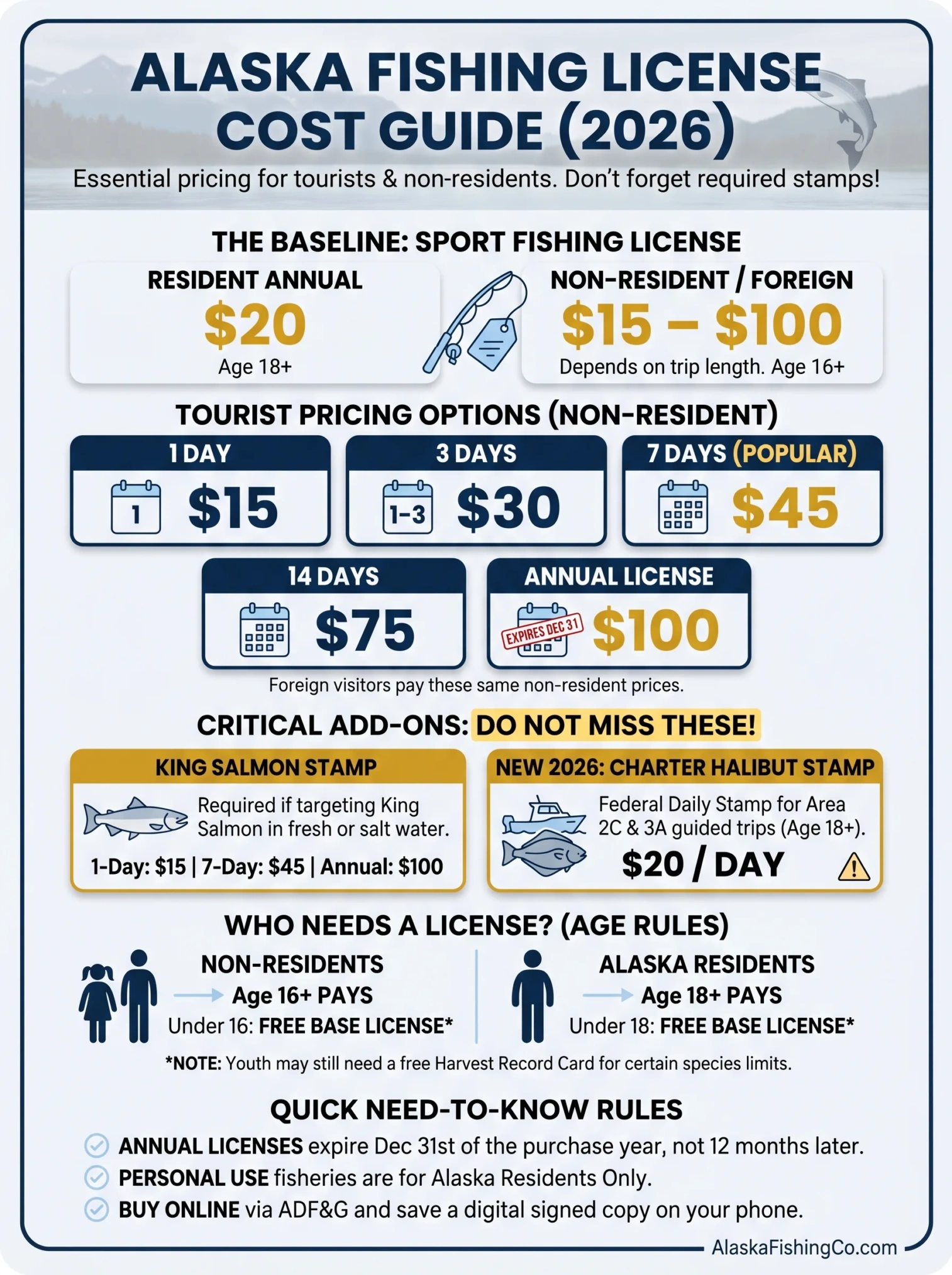
The cost of an Alaska fishing license depends mostly on where you live and how long you plan to fish. For the current 2026 pricing published by Alaska Department of Fish and Game, residents pay $20 for an annual sport fishing license, while nonresidents and most foreign visitors pay $15 for 1 day, $30 for 3 days, $45 for 7 days, $75 for 14 days, or $100 for an annual license.[a]
The base license is not always the full price. If you plan to fish for king salmon, Alaska usually requires a separate king salmon stamp, and some guided halibut trips in 2026 add a federal daily charter halibut stamp as well.[h]
If you remember one thing… buy the license that matches your trip length, then check whether your target species adds another fee. Most pricing mistakes happen when anglers stop at the base license and never check the salmon or charter rules.[h]
What To Know First
- Most visitors need a nonresident license, even if the trip is only one day.[c]
- Foreign visitors usually pay the same sport fishing prices as other nonresidents for Alaska sport fishing licenses.[e]
- King salmon usually require a separate stamp, unless the fishery is for stocked king salmon in lakes or another listed exception applies.[c]
- Annual licenses do not last 12 months from purchase; in Alaska they generally run only through December 31 of that calendar year.[b]
- Personal use fisheries are a different category. They are for Alaska residents only, and some also require permits.[g]
How Much Does an Alaska Fishing License Cost?
The short answer is simple: $20 for a resident annual sport fishing license, and $15 to $100 for a nonresident or foreign visitor sport fishing license depending on trip length.[a]
That simple schedule is one reason Alaska is easier to plan for than many states. The confusion starts when anglers mix the base license with king salmon stamps, senior exemptions, military pricing, and local species rules. The table below separates those pieces so you can price a trip without guessing.
| License or stamp | Resident price | Nonresident / foreign visitor price | Notes |
|---|---|---|---|
| Sport fishing license, 1 day | — | $15 | Short-trip option for visitors only |
| Sport fishing license, 3 days | — | $30 | Often enough for a weekend plus travel day |
| Sport fishing license, 7 days | — | $45 | Common choice for one-week lodge or charter trips |
| Sport fishing license, 14 days | — | $75 | Usually cheaper than stacking shorter licenses |
| Annual sport fishing license | $20 | $100 | Annual means the calendar year, not 12 months from purchase |
| Annual king salmon stamp | $10 | $100 | Separate from the base license when required |
| King salmon stamp, 1 / 3 / 7 / 14 days | — | $15 / $30 / $45 / $75 | Visitors can match the stamp length to the trip |
| Nonresident military annual sport fishing license | — | $20 | Only for active-duty members and dependents permanently stationed in Alaska for less than 12 months |
| Nonresident military annual king salmon stamp | — | $30 | Separate annual king salmon price for that military category |
- Most tourists: use the nonresident row.
- Most foreign visitors: for sport fishing, the same dollar amounts apply as the nonresident schedule shown above.[a]
- Residents: the base sport fishing license is cheap, but it still may not be the full fishing cost if king salmon are part of the plan.
Worth Noting
A lot of older Alaska fishing pages still show the previous nonresident prices of $25, $45, $70, $105, and $145. For 2026 trip planning, use the current ADF&G pricing page instead of older charter posts or stale travel pages.[a]
Who Needs To Pay, and Who Does Not?
Most adults do need a license, but Alaska uses different age cutoffs for residents and nonresidents. Residents need a sport fishing license starting at age 18, while nonresidents need one starting at age 16.[b]
That means a 15-year-old visitor from another state can fish without buying a sport fishing license, while a 17-year-old resident still can fish without one too. At the same time, some young anglers still need a harvest record card when fishing for species with annual limits, so “no license needed” does not always mean “no paperwork at all.”[b]
People who usually must buy a license
- Alaska residents age 18 and older[c]
- Nonresidents age 16 and older[c]
- Foreign visitors who do not meet Alaska residency rules[e]
People who may fish without buying the standard sport fishing license
- Residents under 18[b]
- Nonresidents under 16[b]
- Qualifying Alaska resident seniors age 60 or older who hold an ADF&G permanent identification card[c]
- Qualifying Alaska resident disabled veterans with the proper ADF&G license or identification[b]
How Alaska decides whether you are a resident
For fishing license purposes, Alaska does not treat “resident” as a casual label. A person generally must maintain an Alaska domicile for the 12 consecutive months before applying, intend to remain, and avoid claiming residency benefits somewhere else. Alaska also says a person can qualify as a resident even if that person is an alien, but only if the residency definition is met.[e]
- Tourist from another U.S. state: nonresident
- Visitor from abroad on a fishing trip: usually nonresident or nonresident alien
- New arrival to Alaska last month: still not a resident for license pricing
What The Base Price Does Not Include
The base sport fishing license covers the right to fish, but it does not cover every species or every fishery. In Alaska, the extra cost people miss most often is the king salmon stamp, and in 2026 some guided halibut trips also carry a separate federal daily stamp.[c]
If your trip is built around salmon or charter halibut, you should think of the base license as step one, not the final total.
King salmon stamp
If you are fishing for king salmon, Alaska usually requires a king salmon stamp in addition to the sport fishing license, except for king salmon in stocked lakes and a few listed exempt groups. That rule applies in both fresh and saltwater, so it needs to be part of the trip budget whenever king salmon are part of the plan.[c]
- Resident annual king salmon stamp: $10[a]
- Nonresident king salmon stamp: $15 / $30 / $45 / $75 / $100 for 1 day / 3 days / 7 days / 14 days / annual[a]
- Many resident seniors, resident disabled veterans, resident low-income license holders, and youth anglers still need a harvest record card even when they do not need to buy the stamp itself.[b]
Harvest record cards
Some Alaska species have annual limits. When that happens, anglers of all ages may need to record harvest immediately after landing the fish. This matters because a child or exempt angler may still need a free harvest record card even though no base license was purchased.[b]
- Check the regional regulation book for annual-limit species.
- Carry the record card with you while fishing.
- Write down the harvest right away, not later at the hotel.
Charter halibut stamp in 2026
For 2026, NOAA requires a $20 daily charter halibut stamp for charter vessel anglers age 18 or older who intend to catch and retain halibut in IPHC Area 2C (Southeast Alaska) or 3A (Southcentral Alaska). The stamp is valid for one day, and charter halibut permit holders buy and validate it through the federal system before the trip starts.[h]
- This is not your regular Alaska sport fishing license.
- It matters only for certain guided halibut trips, not every Alaska fishing trip.
- Ask the charter whether the $20 daily amount is already included in the trip price.
One Detail People Miss
A king salmon stamp can turn a “cheap” visitor license into a much bigger number fast. A nonresident who buys a 7-day sport fishing license and a matching 7-day king salmon stamp is paying $90 before a charter, gear, or fish processing is added.[a]
How Long Each License Lasts, and Which One Usually Makes Sense
Annual Alaska sport fishing licenses usually run from the purchase date through December 31 of that same calendar year. Short-term nonresident licenses are sold for 1, 3, 7, or 14 days.[b]
That sounds minor, but it changes the math. If someone arrives in late August for a single week, the annual nonresident license is not automatically the smart buy just because it sounds flexible. The annual license gives more room for another Alaska trip that same year, but it does not roll into the next season.
When each option usually fits best
- 1 day: best for a one-off charter or a cruise stop.
- 3 days: useful for a long weekend or a short side trip.
- 7 days: common for lodge stays and week-long vacations.
- 14 days: often the cleanest option for a longer road trip with several fishing stops.
- Annual: makes sense if you are a resident, a seasonal worker returning to fish multiple times in the same year, or a visitor taking more than one Alaska trip before December 31.
Simple cost examples
- A five-day visitor trip usually means the 7-day license, not the 3-day.
- A ten-day visitor trip usually means the 14-day license, not stacking shorter licenses.
- A resident who fishes often will almost always find the $20 annual resident license the obvious choice.[a]
How Tourists and Foreign Visitors Can Buy Online
Buying online is straightforward, but the license still has to be signed to be valid. Alaska says every license must carry either a physical signature or an electronic signature.[d]
The easiest route for most travelers is to buy through the ADF&G online store before the trip, save a signed digital copy on the phone, and also keep a printable backup. That way there is less pressure on the morning of the charter.
Basic online buying steps
- Create or sign in to an ADF&G account.[d]
- Choose the sport fishing license that matches the trip length.
- Add a king salmon stamp if your plan includes targeting king salmon.
- Complete the eSignature step for your own license.
- Save the signed license to your phone, or print and sign a paper copy.[d]
Important online detail for families and groups
You can buy for another person, but Alaska says you cannot eSign that other person’s license for them. Each person must sign in to their own ADF&G account to eSign their own license.[d]
- Do not assume one parent can finish every signature for the group.
- Do not wait until the dock if several adults need separate sign-ins.
- Bring a charged phone if you plan to carry only the digital version.
Before You Move On
Visitors often ask whether they need a different Alaska price because they are from another country. For sport fishing, the official pricing page shows the same dollar amounts for standard nonresident and foreign or alien sport fishing licenses, even though the hunting side is different.[a]
Regional and Species Rules That Change The Real Cost
The license price itself does not change by river, town, or region, but the usable value of that license can change because species rules do. That matters most with king salmon and with specialized fisheries such as personal use or guided halibut.[f]
This is where many search results fall short. They give the statewide price table and stop there, even though a visitor often wants to know whether that license is enough for the exact trip already booked.
2026 Southeast Alaska king salmon example
ADF&G announced that in marine waters of Southeast Alaska and Yakutat for the 2026 season, nonresidents face a one-fish bag and possession limit for king salmon 28 inches or greater, an annual harvest limit of three fish from January 1 through June 30, and an annual harvest limit of one fish from July 1 through December 31, with early-season harvest counting toward the later limit.[f]
- Your license price stays the same.
- Your trip plan may change a lot.
- Buying the right stamp does not override a seasonal limit.
Personal use is not the same as sport fishing
ADF&G makes this point clearly: personal use fisheries are for Alaska residents only, and a valid resident sport fishing license is required for personal use fisheries, while subsistence has its own separate rules. So a visitor cannot use a nonresident sport fishing license as a shortcut into personal use fisheries.[g]
- Sport fishing: open to residents and nonresidents under sport regulations
- Personal use: Alaska residents only, sometimes with permits
- Subsistence: separate system with separate rules
Common Mistakes About Alaska Fishing License Cost
The most common Alaska pricing mistakes are not math errors. They come from buying the wrong category, stopping at the base price, or trusting an old page that has not been updated.[a]
“The fishing license already covers king salmon.”
What people think: One license covers all sport fishing species.
What is true: King salmon usually need a separate stamp in addition to the sport fishing license.[c]
Why this gets mixed up: Many pages lead with the base license price and mention salmon add-ons later.
“Foreign visitors pay a different sport fishing rate.”
What people think: International visitors must pay a higher Alaska sport fishing price.
What is true: For sport fishing licenses and king salmon stamps, the official price list shows the same dollar amounts for the foreign or alien category as for other nonresidents.[a]
Why this gets mixed up: Alaska uses a separate “nonresident alien” label in some licensing language, and on the hunting side the prices do change.
“Annual means one full year from the day I buy it.”
What people think: Buy in September, stay valid until next September.
What is true: Alaska annual licenses generally run through December 31 of that calendar year.[b]
Why this gets mixed up: Many other passes and memberships work on a rolling 12-month basis.
“Kids never need any fishing paperwork.”
What people think: No license always means no paperwork.
What is true: Youth anglers may still need harvest record cards for species with annual limits.[b]
Why this gets mixed up: Age exemptions are easy to remember; harvest recording rules are easy to miss.
“My charter price includes every required fishing fee.”
What people think: The charter booking takes care of every fishing cost.
What is true: Many charters help, but anglers still need to confirm whether the regular sport fishing license, king salmon stamp, or 2026 charter halibut stamp are included or separate.[h]
Why this gets mixed up: Each operator packages trips a little differently, and federal halibut stamp handling sits with permit holders rather than the usual ADF&G store flow.
Real-Life Scenarios
The price makes more sense when it is attached to a real trip. These examples show how Alaska visitors and residents usually run into the rule set in practice.
- A couple from Seattle books a 4-day coho-focused trip out of Homer.
They will usually need 7-day nonresident sport fishing licenses, and they may not need king salmon stamps if king salmon are not part of the plan. - A traveler from Germany spends 8 days fishing around Juneau and wants to target king salmon.
For sport fishing cost, that visitor is usually priced like any other nonresident: a 14-day sport fishing license plus a 14-day king salmon stamp.[a] - An Anchorage resident fishes all summer but only a few weekends.
The base annual resident sport fishing license is still just $20, which is usually cheaper than overthinking the decision.[a] - A 15-year-old visitor from Oregon joins a family charter.
No Alaska sport fishing license is required for that nonresident under 16, but the family still needs to check whether a harvest record card applies for the species being kept.[b] - An active-duty service member newly stationed in Alaska wants to fish through the season.
If that person fits Alaska’s nonresident military category, the annual military sport fishing license is $20, with a separate annual military king salmon stamp if needed.[a] - A 40-year-old visitor books a halibut charter in Seward and plans to keep fish.
That person still needs the regular Alaska sport fishing license, and the trip may also involve the 2026 federal daily charter halibut stamp because Seward is in Southcentral Alaska Area 3A.[h] - A visitor heads to Southeast Alaska in August for king salmon after reading an old blog.
Even with the correct license and stamp, 2026 Southeast nonresident king salmon harvest limits can be tighter than expected later in the year, so the regional rule page matters just as much as the pricing page.[f]
Before You Buy
Alaska keeps the base sport fishing license prices simple, but the real trip total depends on your residency category, trip length, and whether king salmon or guided halibut are part of the plan. Once those pieces are clear, most anglers can buy the right license in a few minutes and avoid nearly all of the usual mistakes.
The error seen most often is buying only the base license and missing the species-specific add-on or harvest rule.
Easy rule to remember: pick the license for the number of days you will fish, then check the species and charter extras before you ever leave the dock.
Alaska Fishing License Cost Questions Answered
Do tourists need a fishing license in Alaska?
Yes. In general, nonresidents age 16 and older need an Alaska sport fishing license to fish in Alaska waters. Younger nonresidents are exempt from the base license, but some may still need a harvest record card for species with annual limits.
Can foreigners buy an Alaska fishing license online?
Yes. Foreign visitors can buy Alaska sport fishing licenses online, and for sport fishing the listed prices match the standard nonresident pricing schedule. Each person still needs a valid signed license.
Is the king salmon stamp included in the fishing license price?
No. When a king salmon stamp is required, it is a separate purchase from the base sport fishing license unless an exemption applies, such as certain youth or qualifying resident identification categories.
How long is an Alaska nonresident fishing license valid?
Nonresident short-term licenses are sold for 1, 3, 7, or 14 days. Alaska annual licenses usually remain valid through December 31 of the calendar year.
Do children need an Alaska fishing license?
Residents under 18 and nonresidents under 16 do not need a standard Alaska sport fishing license. Even so, some fisheries still require a harvest record card when annual limits apply.
Does a guided halibut trip include every required fishing fee?
Not always. Ask the operator whether your Alaska sport fishing license, any king salmon stamp, and the 2026 daily charter halibut stamp for Areas 2C or 3A are already included or billed separately.
Alaska Fishing References
- ADF&G: Prices for Sport Fishing Licenses and King Salmon Stamps — Used for current 2026 resident, nonresident, foreign visitor, and military sport fishing prices. (Reliable because it is the official Alaska Department of Fish and Game pricing page.)
- ADF&G: General License Information — Used for age rules, validity periods, harvest record notes, and senior or disabled veteran details. (Reliable because it is an official Alaska state licensing reference page.)
- ADF&G: Sport Fishing Licenses and King Salmon Stamps — Used for the statewide rule that licenses apply in fresh and saltwater, king salmon stamp requirements, purchase locations, and youth or identification-card exceptions. (Reliable because it is the official ADF&G sport fishing license page.)
- ADF&G: Purchasing Your License Online and eSigning Your License FAQ — Used for online buying steps, signature rules, and carrying a digital or printed signed license. (Reliable because it is an official ADF&G purchasing and compliance FAQ.)
- ADF&G: Residency Definitions — Used to explain who qualifies as a resident, nonresident, or nonresident alien for license pricing. (Reliable because it states Alaska’s official residency definitions for Fish and Game licensing.)
- ADF&G: Southeast Alaska Regional King Salmon Sport Fishing Regulations for 2026 — Used for the 2026 Southeast and Yakutat nonresident king salmon annual limit example. (Reliable because it is a current ADF&G advisory announcement for the 2026 season.)
- ADF&G: Subsistence and Personal Use Fishing Licenses and Permits — Used to explain that personal use fisheries are for Alaska residents only and may require permits. (Reliable because it is the official ADF&G page for those fishing categories.)
- NOAA Fisheries: Charter Halibut Stamp Program FAQ and Small Entity Compliance Guide — Used for the 2026 daily charter halibut stamp rule, age threshold, one-day validity, and $20 fee in Areas 2C and 3A. (Reliable because it is a federal NOAA Fisheries compliance document for the live rule.)