
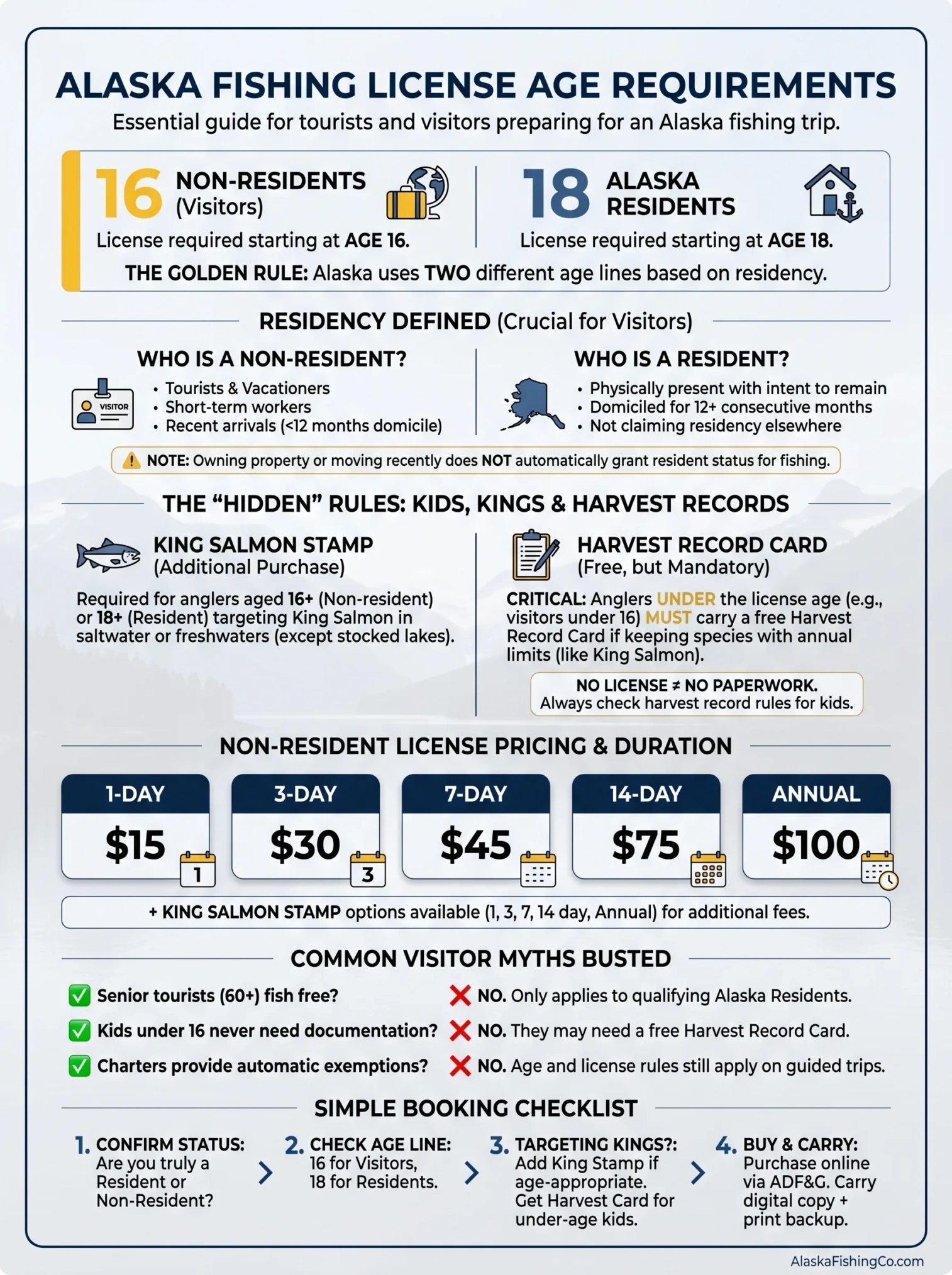
In Alaska, the age rule is simple: residents need a sport fishing license starting at age 18, and nonresidents need one starting at age 16. Below those ages, a standard sport fishing license is not required for sport fishing, but young anglers still have to follow seasons, bag limits, and harvest-record rules where they apply.[a]
That same age split applies in both freshwater and saltwater. It also does not disappear just because the trip is on a charter, on a dock, or during a family vacation. If king salmon are part of the plan, there is one more layer to check.[b]
If you remember one thing… Alaska uses two different age lines: 18 for residents, 16 for visitors.
What To Know First
- Resident under 18: no standard sport fishing license.
- Nonresident under 16: no standard sport fishing license.
- King salmon rules are separate: some young anglers still need a free harvest record card.
- Visitor status matters: living in Alaska for a short time does not usually make someone a resident.
- Area rules still control the trip: closures, annual limits, and emergency orders can change what is legal.
Who Needs an Alaska Fishing License by Age?
The direct answer: if someone is an Alaska resident, the license requirement starts at 18. If someone is a nonresident, including most tourists and foreign visitors, it starts at 16.[a]
That is the basic rule most people need. A 17-year-old visitor from Seattle needs a nonresident sport fishing license. A 17-year-old who truly qualifies as an Alaska resident does not. A 15-year-old tourist does not need a standard sport fishing license, but that does not mean every document rule disappears.
- Residents age 17 and under: no standard sport fishing license for normal sport fishing.
- Residents age 18 and older: license required.
- Nonresidents age 15 and under: no standard sport fishing license.
- Nonresidents age 16 and older: license required.
Resident vs Nonresident Age Rules
The direct answer: the most common mistake is assuming Alaska uses one age rule for everyone. It does not. Alaska gives residents a later starting point and visitors an earlier one.[a]
This matters because families often travel with teenagers who are right on the line. It also matters for people who recently moved to Alaska and think a local address is enough. For fishing-license purposes, Alaska residency has its own definition. In plain terms, the state looks for real residency, not a short stay or a vacation rental.[e]
| Angler type | Standard sport fishing license needed? | King salmon stamp needed if targeting king salmon? | What to watch for |
|---|---|---|---|
| Alaska resident under 18 | No | No standard stamp purchase, but harvest record rules can still apply | Annual-limit fish may still need recording |
| Alaska resident 18+ | Yes | Yes, unless another listed exemption applies | Carry license and record annual-limit harvest immediately |
| Nonresident under 16 | No | No standard stamp purchase, but harvest record rules can still apply | Visitor children still follow seasons and bag limits |
| Nonresident 16+ | Yes | Yes, if fishing for king salmon outside stocked lakes | Short-term license options are available |
| Foreign visitor | Same age rule as a nonresident visitor | Same fishing-stamp rule as other nonresidents | Do not assume age or senior discounts based on home country |
- One family can have mixed rules: the adults may need licenses while younger children do not.
- Teenagers are where mistakes happen most: age 16 for visitors and age 18 for residents are the two lines to remember.
- Moving to Alaska does not change status overnight: the residency definition still has to be met.
Worth Noting
A 60+ free identification card is for Alaska residents, not for older tourists. Many visitors assume senior status removes the license requirement, but that exemption is tied to Alaska residency.[a]
When Children Still Need a Harvest Record Card or King Salmon Documentation
The direct answer: being under the license age does not always mean “nothing to carry.” In Alaska, young anglers may still need a free Sport Fishing Harvest Record Card when they keep fish from species with an annual limit, and that point gets missed all the time.[b]
ADF&G says harvest records are required when anglers keep species with annual limits. For adults who bought a regular license, that record is usually made on the license itself. For resident anglers under 18 and nonresident anglers under 16, the state uses a separate free harvest record card. This comes up in many king salmon fisheries and in some fisheries for other annual-limit species listed in the regional rule books.[b]
King salmon are where the issue becomes most visible. Alaska requires a king salmon stamp for anglers fishing for king salmon, except king salmon in stocked lakes. But residents under 18 and nonresidents under 16 do not buy that stamp. Instead, they still need the right harvest-record paperwork if the fishery requires harvest recording.[a]
- Under the age threshold does not remove bag limits.
- Under the age threshold does not remove annual-limit recording.
- Under the age threshold does not override king-salmon area rules.
How Long Alaska Fishing Licenses Last and What Adults Pay
The direct answer: once someone is old enough to need a license, Alaska gives residents a calendar-year annual license and gives nonresidents several short-term options as well as an annual option.[c]
For age-rule planning, this matters most when a child is about to turn 16 or 18 during the trip year, or when a family is deciding whether only one or two days of fishing are worth it. Alaska’s standard license-validity rule is simple: most licenses run from the date of purchase through December 31 of that year, while short-term nonresident sport fishing licenses are valid for only the number of days purchased.[a]
Current ADF&G pricing lists these common sport-fishing options for anglers who are old enough to need them:[c]
- Resident annual sport fishing license: $20
- Nonresident 1-day sport fishing license: $15
- Nonresident 3-day sport fishing license: $30
- Nonresident 7-day sport fishing license: $45
- Nonresident 14-day sport fishing license: $75
- Nonresident annual sport fishing license: $100
For king salmon, adults who need the stamp face a separate charge. Residents 18 and older pay $10 for the annual resident king salmon stamp. Nonresidents who are old enough to need one can buy 1-day, 3-day, 7-day, 14-day, or annual stamp options that mirror the short-term license structure.[c]
- Weekend trip: short-term nonresident license is usually enough.
- Multi-stop Alaska trip: check whether 7-day or 14-day works better than buying more than once.
- Adults targeting king salmon: price the stamp separately.
One Detail People Miss
A child who is below the license age can still cost the family time if no one checked the harvest-record rule before leaving the dock. The missing item is usually not the standard license. It is the free record card.[b]
How Foreign Visitors and New Alaska Arrivals Are Treated
The direct answer: most foreign tourists and most people who recently moved to Alaska are treated as nonresidents for fishing-license purposes until they actually meet Alaska’s residency test.[e]
ADF&G defines an Alaska resident as a person, including an alien, who is physically present in Alaska with the intent to remain indefinitely, has kept a domicile in Alaska for the 12 consecutive months before applying, and is not claiming residency benefits somewhere else. That is a much narrower standard than “I rent an apartment here now” or “I am here for the summer.”[e]
For sport fishing, the practical result is easy to use:
- Foreign tourist: use the nonresident age line of 16.
- Person who moved to Alaska a few months ago: usually still use the nonresident age line of 16.
- Long-term Alaska resident family: use the resident age line of 18.
ADF&G’s price list also shows that foreign or alien sport-fishing prices match the normal nonresident fishing prices. So for ordinary visitor trip planning, the age rule and the short-term fishing prices are effectively the same as they are for other nonresident anglers.[c]
How to Buy the Right License Online
The direct answer: Alaska makes online purchase fairly simple, and adults who need a license can carry it in paper or approved electronic form after purchase.[f]
The cleanest way to avoid age-rule mistakes is to work through the ADF&G online store before the trip. Once the adult anglers are sorted by resident or nonresident status and by age, the right license option becomes obvious. Alaska also allows several ways to carry a purchased license, including a printed signed copy and an electronic version on a phone.[f]
Simple online buying flow
- Confirm whether the angler is an Alaska resident or a nonresident.
- Check the angler’s age against the correct line: 18 for residents, 16 for nonresidents.
- Choose the right duration if a license is needed.
- Add a king salmon stamp if the trip includes king salmon outside stocked lakes and the angler is old enough to need the stamp.
- If a young angler may keep fish from an annual-limit fishery, print or obtain the free harvest record card.
- Carry the signed document in a valid paper or digital form.
ADF&G also says its mobile app can display licenses, permits, regulations, and harvest recording tools in the field. That can help families who would rather keep all documents on one phone, though many anglers still print backup copies before traveling into weak-signal areas.[g]
- Best time to buy: before the travel day, not in the parking lot.
- Best habit: save a digital copy and keep a printed backup.
- Best check before paying: make sure each angler is marked as resident or nonresident correctly.
Before You Move On
The age rule decides whether you buy a standard license. It does not decide the season, open area, bag limit, or whether a fish has to be recorded right away.[h]
Common Mistakes About Alaska Fishing Age Rules
The direct answer: most errors happen because people stop reading after they learn that a child “doesn’t need a license.” That statement is only partly useful.[a]
“My child is under the age line, so there is nothing else to do.”
- What people think: No license means no paperwork.
- What is actually true: Young anglers may still need a free harvest record card for annual-limit species.
- Why it gets mixed up: Families hear “no license required” and assume it covers every fishery document.
“A 17-year-old is always exempt in Alaska.”
- What people think: Anyone under 18 fishes free.
- What is actually true: That only works for Alaska residents. A 17-year-old visitor needs a nonresident license.
- Why it gets mixed up: Many states use one youth line for everyone, but Alaska splits the rule by residency.
“Senior visitors do not need a fishing license.”
- What people think: Age alone creates a senior exemption.
- What is actually true: The no-fee senior identification card is tied to Alaska residency.
- Why it gets mixed up: Some states give broad senior breaks, and travelers expect Alaska to work the same way.
“If the charter is handling the trip, the age rule changes.”
- What people think: Guided or charter fishing comes with a blanket exception.
- What is actually true: The same resident/nonresident age lines still apply in saltwater and guided fishing.
- Why it gets mixed up: Some charter businesses help with buying licenses, which makes it feel like the license is optional.
“A king salmon stamp never matters for kids.”
- What people think: Young anglers can ignore all king salmon paperwork.
- What is actually true: Young anglers below the age line do not buy the stamp, but harvest-record requirements can still apply when king salmon are involved.
- Why it gets mixed up: People confuse the stamp purchase rule with the harvest-record rule.
Real-Life Scenarios
The direct answer: the easiest way to use Alaska’s age rule is to test it against ordinary visitor situations before the trip starts.
- A 15-year-old visitor from California wants to fish from shore near Homer.
No standard nonresident sport fishing license is needed, but local species, season, and harvest-record rules still have to be checked. - A 16-year-old tourist is booked on a halibut charter out of Seward.
A nonresident sport fishing license is required because the visitor has reached Alaska’s nonresident age line. - A 17-year-old who lives full-time in Anchorage is fishing a local stocked lake.
No standard resident sport fishing license is required because Alaska residents do not need one until 18. - A 14-year-old foreign visitor wants to fish for king salmon with family.
No standard sport fishing license or bought king-salmon stamp is required, but the family must still check whether a free harvest record card is needed for that fishery. - A 62-year-old tourist from Texas assumes age removes the requirement.
It does not; the resident senior identification-card break is not a general visitor exemption. - A family moved to Alaska four months ago and thinks the 17-year-old is now a resident for fishing.
Usually not yet; Alaska residency for license purposes uses a 12-consecutive-month standard and other residency conditions. - A 15-year-old visitor is below the license age, but the area has a king salmon closure.
The child still cannot legally fish around that closure, because emergency orders and local regulations apply to everyone in the fishery.
Regional and Seasonal Checks That Still Matter
The direct answer: age tells you whether to buy the license, but Alaska’s regional regulations tell you whether the trip itself is open, what can be kept, and what must be recorded.[h]
ADF&G divides sport-fishing regulations by region, and area-specific pages tell anglers to check the exact drainage or area they plan to fish. Just as important, ADF&G says emergency orders can open or close areas, raise or reduce bag limits, and change methods. Those orders can be issued at any time and have the same force as law.[h]
That means a family can get the age rule right and still get the trip wrong if they never check the local regulation page before leaving. This happens most often with king salmon, where the printed booklet, emergency order page, and local limits all need a quick look.
- First check: resident or nonresident status.
- Second check: age line for the license itself.
- Third check: species-specific rules, especially king salmon.
- Fourth check: the exact area and any emergency order posted before the trip.
For most travelers, Alaska’s age requirement is not hard once it is stated plainly. Residents start at 18. Visitors start at 16.
The mistake seen most often is assuming “no license needed” also means “no record card, no king-salmon rule, and no local check.”
A good rule to remember is this: first sort the angler by residency, then by age, then by species and location.
Alaska Fishing License Age Questions Answered
Do tourists need a fishing license in Alaska?
Yes, if they are nonresidents age 16 or older. Tourists under 16 do not need a standard sport fishing license, but they still need to follow all local fishing rules.
Can foreigners buy an Alaska fishing license online?
Yes. Foreign visitors are generally treated under the nonresident fishing structure, and Alaska allows online purchase through ADF&G.
Does a 15-year-old need an Alaska fishing license?
Not if the angler is a nonresident visitor or a resident child, because both are below Alaska’s standard sport-fishing age line. The family should still check harvest-record and local species rules.
Does a 16-year-old need a fishing license in Alaska?
A 16-year-old nonresident does. A 16-year-old Alaska resident does not need a standard sport fishing license yet.
Do kids need a king salmon stamp in Alaska?
Resident anglers under 18 and nonresident anglers under 16 do not buy the standard king salmon stamp, but harvest-record rules can still apply when king salmon are involved.
How long is an Alaska nonresident fishing license valid?
Nonresident sport-fishing licenses can be bought for 1, 3, 7, or 14 days, or as an annual license. The short-term options are only valid for the duration purchased.
Do senior tourists get a free fishing license in Alaska?
No. Alaska’s senior no-fee identification card is for qualifying Alaska residents, not for out-of-state or international visitors.
Alaska Fishing References
- Fishing and Hunting License: General License Information — used for the resident age 18 and nonresident age 16 split, license-validity rules, senior resident identification-card note, and the king salmon stamp exception language. (Reliable because it is an official Alaska Department of Fish and Game licensing page.)
- Sport Fishing Annual Harvest Record Card — used for the youth harvest-record requirement and the rule that annual-limit species must be recorded immediately. (Reliable because it is an official ADF&G form and instruction sheet.)
- Sport Fishing Licenses and King Salmon Stamps: Prices — used for current resident, nonresident, and foreign/alien sport-fishing prices and king salmon stamp fees. (Reliable because it is the official ADF&G price schedule.)
- Residency Definitions — used to explain who counts as an Alaska resident, who counts as a nonresident, and why a recent move does not usually change status right away. (Reliable because it is the official ADF&G residency-definition page tied to Alaska licensing.)
- Purchasing Your License Online FAQ — used for online purchase, license formats, and valid paper/electronic carrying options. (Reliable because it is an official ADF&G licensing FAQ.)
- ADF&G Mobile App — used for the app’s ability to display licenses, regulations, and harvest recording tools in the field. (Reliable because it is the official ADF&G mobile-app information page.)
- Emergency Orders & Press Releases — Sport Fish — used for the point that emergency orders may change seasons, areas, limits, and methods and must be checked before fishing. (Reliable because it is ADF&G’s official sport-fishing emergency-order page.)