
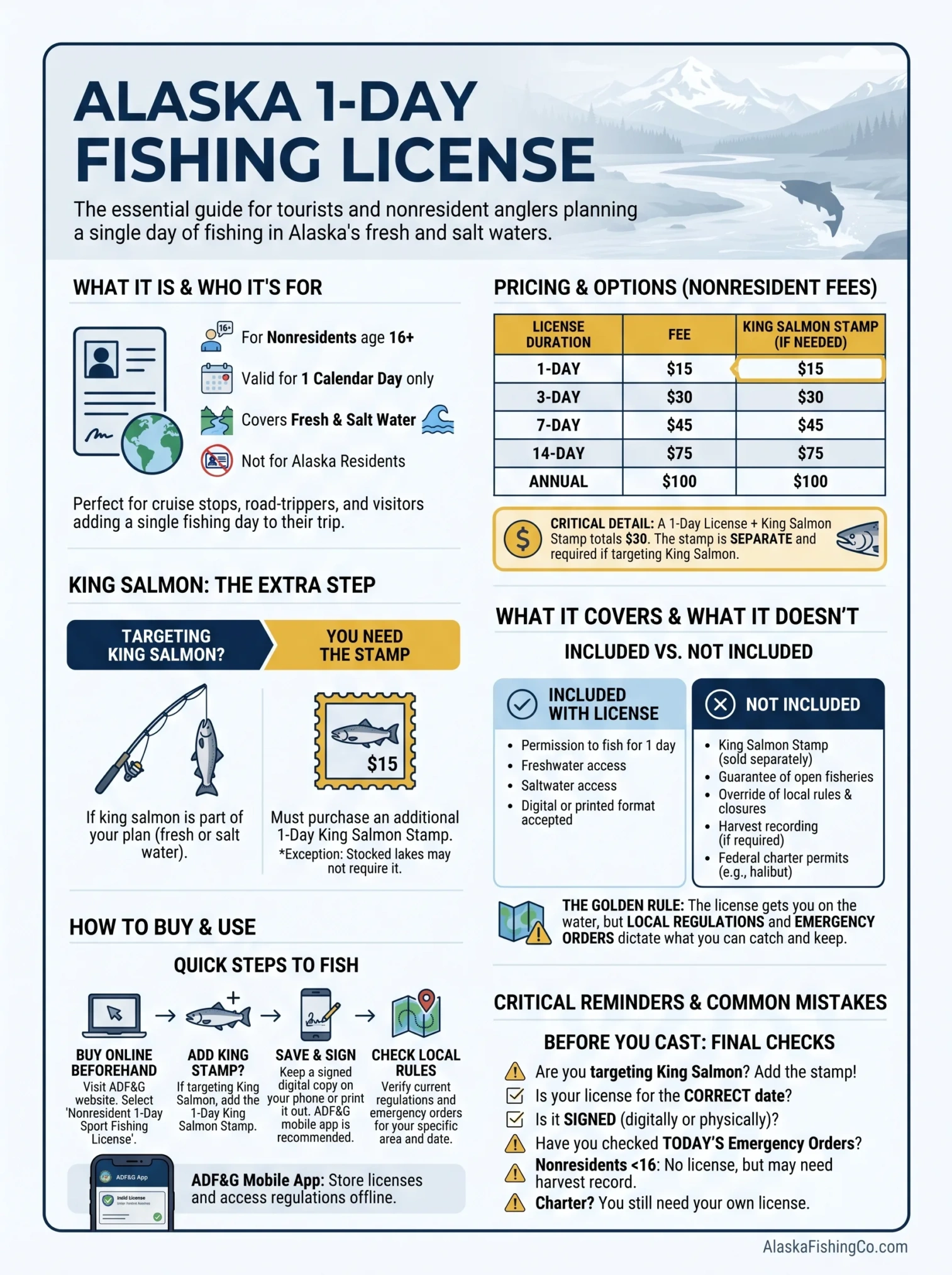
The Alaska 1-day fishing license is the short-term sport fishing license most visitors use when they plan to fish on just one day. The current nonresident fee is $15, and a separate 1-day king salmon stamp is also $15 if king salmon is part of the trip.[b]
Nonresidents age 16 and older need a sport fishing license in Alaska, and that rule applies in both fresh water and salt water. If the plan is to fish for king salmon, an extra stamp is usually required, except when fishing for king salmon in stocked lakes.[a]
If you remember one thing… the 1-day license is the right fit for a one-day Alaska trip only if you are a nonresident, but it does not replace local species rules, seasonal limits, or emergency orders that can change what is open on the day you fish.[e]
What To Know First
- The Alaska 1-day license is built for nonresidents, not for Alaska residents.
- Most tourists, cruise passengers, and out-of-state visitors age 16+ need one if they will fish.
- Foreign visitors can buy the nonresident version too, and the listed 1-day fee is the same.[b]
- If king salmon is on the plan, budget for the extra king salmon stamp.
- A valid license still does not override local closures, bag limits, recording rules, or same-season changes.
- Buying online before the trip is usually the easiest move.
Who This License Is For
The Alaska 1-day fishing license is meant for visitors who will fish on one day only. Current ADF&G pricing lists a 1-day sport fishing license for nonresidents and foreign/alien nonresidents, while resident sport fishing is sold as an annual license rather than a daily one.[b]
That makes this license a practical fit for short Alaska trips where fishing is just one part of the day, not the whole vacation.
- Cruise stop anglers: fishing for a few hours in Ketchikan, Juneau, Seward, or another port.
- Road-trip visitors: fishing one river or one charter day during a longer Alaska drive.
- Business or family travelers: adding a single fishing day to an otherwise non-fishing trip.
- Foreign visitors: buying as a nonresident category, with Alaska using separate residency definitions for nonresident and nonresident alien status.[f]
It is not the normal short-term choice for Alaska residents. If someone qualifies as an Alaska resident for licensing, the standard sport fishing license on the current pricing page is annual.
Price, Length, and When It Makes Sense
The short answer is simple: the 1-day nonresident sport fishing license costs $15, and it is one of Alaska’s short-term nonresident license options. ADF&G says short-term nonresident fishing licenses are valid only for 1, 3, 7, or 14 days, so the 1-day license works best when you know you will fish on just one day.[c]
If you are deciding between short-term options, it helps to compare the total cost before buying. The 1-day license is cheap for a single outing, but it stops being the best value once extra fishing days get added.
- One fishing day: the 1-day license is usually the cleanest option.
- Two separate fishing days: two 1-day licenses cost $30, which is the same price as a 3-day license.
- A full fishing week: the 7-day license often makes more sense than stacking daily licenses.
- Several trips in one year: the annual nonresident license can be cheaper and simpler.
| License option | Fee | Best use | King salmon note |
|---|---|---|---|
| 1-day | $15 | One charter day, one port stop, one river outing | Add a 1-day king salmon stamp if targeting king salmon |
| 3-day | $30 | Weekend trip or two fishing days with a buffer day | Matching 3-day king salmon stamp is $30 |
| 7-day | $45 | One Alaska fishing week | Matching 7-day king salmon stamp is $45 |
| 14-day | $75 | Longer vacation with several fishing days | Matching 14-day king salmon stamp is $75 |
| Annual | $100 | Repeat trips in the same year | Annual king salmon stamp is $100 |
The fee table above follows the current Alaska Department of Fish and Game pricing list.[b]
One Detail People Miss
If king salmon is the target, a “cheap one-day trip” can become a $30 day in license costs once the matching 1-day king salmon stamp is added. That catches people by surprise more often than the base license fee does.
What the 1-Day License Covers, and What It Does Not
A 1-day Alaska sport fishing license lets a qualified nonresident fish in Alaska’s fresh and salt waters for the short-term period they purchased, but it does not erase species rules, area rules, harvest recording rules, or seasonal changes that apply where they are fishing.[a]
That distinction matters because many visitors hear “license” and think it is the whole rulebook. It is not. It is the permission to participate, but the place, species, and timing still control the rest.
- It covers fresh and salt water: rivers, lakes, and saltwater trips all still require the sport fishing license when the age rule applies.
- It does not replace a king salmon stamp: if you are fishing for king salmon, the extra stamp is usually still required.
- It does not cancel harvest recording duties: some fisheries with annual limits require harvest to be recorded right away on the license or a harvest record card.[c]
- It does not override same-season changes: Alaska can open, close, or restrict fisheries by emergency order, and those orders carry the force of law.[e]
- It does not settle every federal issue: charter halibut retention in parts of Alaska can involve separate federal rules beyond the state sport license.[h]
That last point is easy to overlook. In 2026, ADF&G had already posted multiple king salmon closures and restrictions in parts of Southcentral and Southeast Alaska, which is a good reminder that holding a valid license does not mean every fishery is open for harvest that day.[e]
Buying It Online Without Slowing Down Your Trip
The easiest path for most visitors is to buy before the trip through ADF&G and keep the license ready on a phone or in printed form. Alaska also recognizes licenses displayed through the ADF&G mobile app as valid in the field.[g]
The online process is usually straightforward if you do it before you head to the dock, river pullout, or charter check-in.
- Go to the Alaska Department of Fish and Game license store.
- Select the right residency category. Most tourists choose a nonresident option. Foreign visitors should pay attention to Alaska’s nonresident and nonresident alien definitions if they are unsure.[f]
- Choose the 1-day sport fishing license.
- Add a king salmon stamp if king salmon will be targeted.
- Save the license properly. ADF&G says printed or electronic licenses can be carried after signing, including a signed version on a phone.[c]
- Check local regulations and same-day emergency orders before leaving for the water.
If you like keeping everything in one place, the mobile app is useful because it can display licenses and current regulations on the device, including offline regulation access once downloaded.[g]
Worth Noting
An unsigned license is a bad last-minute surprise. If you are carrying a PDF version on your phone, make sure it is signed before the trip starts.
Common Mistakes People Make
Most license mistakes are not about price. They happen because visitors assume the charter, the town, or the species somehow changes the basic rule. It usually does not.
-
Wrong idea: “My guide or charter covers the license for me.”
What is correct: Each angler usually needs their own valid sport fishing license when the age rule applies.
Why people mix it up: The charter handles a lot of logistics, so visitors assume licensing is part of the package. -
Wrong idea: “The 1-day license already includes king salmon.”
What is correct: A separate king salmon stamp is usually needed if you are fishing for king salmon.
Why people mix it up: Many states bundle salmon or saltwater access differently, and Alaska does not use that model here. -
Wrong idea: “Saltwater trips do not need a license.”
What is correct: Alaska’s sport fishing license rule applies in both fresh and marine waters.
Why people mix it up: In some places, pier fishing, charter rules, or local saltwater exemptions create different expectations. -
Wrong idea: “My 15-year-old needs nothing at all.”
What is correct: A nonresident under 16 does not need the sport fishing license, but annual-limit fisheries can still require a harvest record card.
Why people mix it up: “No license needed” sounds like “no paperwork needed,” and those are not always the same thing. -
Wrong idea: “A valid license means the fishery is open.”
What is correct: Local regulations and emergency orders can still close the area, reduce retention, or change methods.
Why people mix it up: License status and fishery status sound like the same thing when they are really separate. -
Wrong idea: “A screenshot or saved email is enough.”
What is correct: Carry a valid, signed license in an accepted format, or keep it in the ADF&G mobile app.
Why people mix it up: Travel days are rushed, and people assume payment proof is the same as a field-valid license.
Real-Life Visitor Scenarios
The 1-day Alaska license makes sense in a lot of normal travel situations, but only when the rest of the trip matches what the license is built for.
1) Cruise stop in Ketchikan with a morning salmon trip
The 1-day nonresident license is usually the right fit, and a king salmon stamp is added only if king salmon is part of that specific trip.
2) Seward halibut charter on a single vacation day
A 1-day Alaska sport fishing license can fit the state license side of the trip, but charter halibut rules may still involve separate federal requirements depending on the area and trip type.[h]
3) Family trip on the Kenai with one adult and one 15-year-old visitor
The adult nonresident needs the license, while the 15-year-old generally does not need the sport fishing license, though annual-limit fisheries can still create recording duties.
4) Two separate fishing days during the same Alaska week
Two 1-day licenses cost the same as a 3-day license, so the 3-day option is often easier if there is any chance the trip shifts by weather or travel delays.
5) Visitor fishing for trout one day and king salmon another day
A single 1-day license only fits one day, and the king salmon day may also require the extra stamp.
6) Tourist in Southeast hoping to keep king salmon
The 1-day license and king salmon stamp may still not be enough by themselves because local 2026 restrictions can limit retention or close harvest in some places.[e]
7) Alaska resident fishing with an out-of-state friend for one afternoon
The out-of-state visitor can use the 1-day nonresident license, but the Alaska resident normally looks at the annual resident license instead of any daily option.
Before You Move On
The best use of the 1-day license is a trip with a fixed fishing day. Once the trip starts to spread across several days, Alaska’s 3-day or 7-day option often becomes the safer pick.
Last Check Before You Fish
Before you leave for the water, treat the license as only one part of the job. Alaska publishes sport fishing regulations by area, and it also updates emergency orders frequently when in-season conditions force changes.[d]
- Have the correct 1-day nonresident license for the day you will fish.
- Add the king salmon stamp if king salmon is on the plan.
- Carry the license in a valid signed format.
- Check the area regulations for the water you will fish.
- Check same-day emergency orders before you go.[e]
- If the fishery has an annual limit, know how and where harvest must be recorded.
For most visitors, the right move is simple: buy the 1-day nonresident license for the day you will fish, add the extra stamp only if king salmon is part of the plan, and check the local rules before leaving. That handles most Alaska day-trip situations without paying for days you will not use.
The mistake people make most often is assuming the license itself tells them what they can keep.
The rule worth remembering is this: the license gets you on the water, but the local regulations decide what happens once you are there.
Alaska 1-Day Fishing License Questions Answered
Do tourists need a 1-day fishing license in Alaska?
Yes, most tourists who are nonresidents and age 16 or older need an Alaska sport fishing license if they will fish. The 1-day version is the short-term choice when they plan to fish on one day only.
Can foreigners buy an Alaska 1-day fishing license online?
Yes. Alaska lists nonresident and foreign/alien nonresident sport fishing license pricing, and foreign visitors can buy the short-term nonresident option that matches their status.
Do I need a king salmon stamp with a 1-day Alaska fishing license?
If you are fishing for king salmon, usually yes. Alaska requires a separate king salmon stamp in addition to the sport fishing license, except for king salmon in stocked lakes.
Is the Alaska 1-day fishing license valid in saltwater and freshwater?
Yes. Alaska’s sport fishing license requirement applies in both fresh water and marine waters when the angler falls within the age and residency rule.
Is a phone copy of the license enough in Alaska?
It can be, if it is carried in a valid format. Alaska allows valid licenses to be displayed on a mobile device, including through the ADF&G mobile app, and printed or electronic licenses need to be signed properly.
Do nonresident children need an Alaska fishing license?
Nonresidents under age 16 do not need the sport fishing license. Even so, some annual-limit fisheries may still require harvest recording on a harvest record card.
Does a 1-day license guarantee that I can keep fish anywhere in Alaska?
No. A valid license does not override local regulations, species limits, seasonal closures, or emergency orders that can change what is open or what can be retained.
Alaska Fishing References
-
Sport Fishing Licenses and King Salmon Stamps, Alaska Department of Fish and Game
— Used for the base license rule, age thresholds, freshwater and saltwater coverage, online purchase availability, the king salmon stamp requirement, and the stocked-lake exception. (Reliable because it is the official State of Alaska Department of Fish and Game licensing page for sport fishing.) -
Prices: Sport Fishing Licenses and King Salmon Stamps, Alaska Department of Fish and Game
— Used for the current listed fees for 1-day, 3-day, 7-day, 14-day, and annual nonresident licenses, plus the matching king salmon stamp prices and the current resident annual price. (Reliable because it is the official Alaska state pricing page for licenses and stamps.) -
General Information Frequently Asked Questions, Fishing and Hunting Licenses, Alaska Department of Fish and Game
— Used for short-term license validity, accepted license formats, signing rules for printed or electronic copies, and harvest record card rules for species with annual limits. (Reliable because it is an official ADF&G FAQ explaining how Alaska licensing works in practice.) -
Sport Fishing Regulations, Alaska Department of Fish and Game
— Used for the statewide regulations portal that organizes Alaska sport fishing rules by area. (Reliable because it is the official ADF&G regulations hub for current sport fishing rule books and area summaries.) -
Emergency Orders and Press Releases, Sport Fishing, Alaska Department of Fish and Game
— Used for Alaska’s in-season closures, restrictions, openings, and same-season rule changes that can affect a trip even when an angler already has a valid license. (Reliable because it is the official ADF&G emergency order page, and those orders have the force of law.) -
Residency Definitions, Alaska Department of Fish and Game
— Used for Alaska’s definitions of resident, nonresident, nonresident military, and nonresident alien. (Reliable because it is the official ADF&G residency definitions page used for license classification.) -
ADF&G Mobile App, Alaska Department of Fish and Game
— Used for the rule that licenses displayed in the app are valid in the field and for the app’s regulation access features. (Reliable because it is the official Alaska Department of Fish and Game page for the state’s own app.) -
Pacific Halibut Recreational Quota Entity Program Fee Collection, NOAA Fisheries
— Used for the federal charter halibut stamp requirement that can apply to adult charter anglers intending to retain halibut in IPHC Areas 2C and 3A. (Reliable because NOAA Fisheries is the federal regulatory authority for this program.)